
- Catálogos
- Depuy Synthes
- Variable Angle LCP Forefoot/Midfoot System 2.4/2.7


Variable Angle LCP Forefoot/Midfoot System 2.4/2.7
1 /40Páginas

Variable Angle LCP Forefoot/Midfoot System 2.4/2.7
1 /40Páginas
Extractos del catálogo
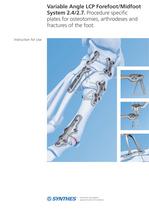
Variable Angle LCP Forefoot/Midfoot System 2.4/2.7. Procedure specific plates for osteotomies, arthrodeses and
Abrir la página 1 del catálogo
Introduction VA-LCP Forefoot/Midfoot Plates 2.4/2.7 2 Controlled Compression Technique 6 Screw Insertion Techniques 9 Surgical Technique Preparation 10 Product Information Screws 27 Synthes Biomaterials Overview 36 A Image intensifier control This description alone does not provide sufficient background for direct use of the product. Instruction by a surgeon experienced in handling this product is highly recommended Reprocessing, Care and Maintenance of Synthes Instruments For general guidelines, function control and dismantling of multi-part instruments, please contact your local sales representative...
Abrir la página 3 del catálogo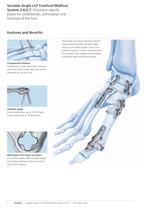
Variable Angle LCP Forefoot/Midfoot System 2.4/2.7. Procedure specific plates for osteotomies, arthrodeses and Compression feature Compression holes used with compres- sion wires and forceps allow for tactile Variable angle Screw holes allow up to 1 5° off-axis screw angulation in all directions. Minimized soft tissue irritation Low profile plates with rounded edges and highly polished surface minimize soft tissue irritation. The system consists of general and pro- cedure-specific plates, variable angle locking and cortex screws, and a com- pression feature, to aid in reconstructive foot surgery....
Abrir la página 4 del catálogo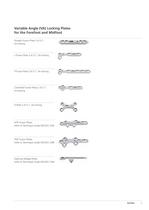
Variable Angle (VA) Locking Plates Straight Fusion Plate 2.4/2.7, L-Fusion Plate 2.4/2.7, VA locking T-Fusion Plate 2.4/2.7, VA locking Cloverleaf Fusion Plate 2.4/2.7, (refer to Technique Guide 036.001.234) (refer to Technique Guide 036.001.238) Opening Wedge Plates (refer to Technique Guide 036.001.236)
Abrir la página 5 del catálogo
AO Principles In 1958, the AO formulated four basic principles, which have become the guidelines for internal fixation.1, 2 The principles as applied to the Variable Angle LCP Forefoot / Midfoot System 2.4 / 2.7 are as follows: Anatomic reduction The use of variable angle locking technology allows fragment specific fixation by providing the flexibility to lock screws in trajectories that can diverge from the central axis of the plate hole. Variable screw angles provide fixation options for a variety of fracture patterns. Stable fixation Variable angle locking screws create a locked construct,...
Abrir la página 6 del catálogo
Indications The Straight Fusion Plates, T-Fusion Plates, L-Fusion Plates, Cloverleaf Fusion Plates and X-Plates of the Variable Angle LCP Forefoot / Midfoot System 2.4 / 2.7 are indicated for fractures, deformations, revisions and replantations of bones (e.g. tarsals, metatarsals and phalanges) and bone fragments, particularly in osteopenic bone. Synthes 5
Abrir la página 7 del catálogo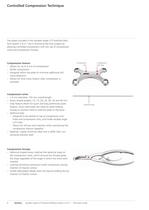
Controlled Compression Technique The plates included in the Variable Angle LCP Forefoot / Midfoot System 2.4 / 2.7 aid in reconstructive foot surgery by allowing controlled compression with the use of compression wires and compression forceps. Compression feature – Allows for up to 4 mm of compression – Tactile compression – Designed within the plate to minimize additional soft tissue dissection – Allows for final screw fixation after compression is achieved Compression wires – 1.6 mm diameter, 150 mm overall length – Seven thread lengths: 10, 15, 20, 25, 30, 35 and 40 mm – Stop feature allows...
Abrir la página 8 del catálogo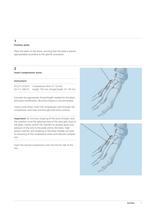
1 Position plate Place the plate on the bone, ensuring that the plate is placed appropriately according to the specific procedure. 2 Insert compression wires Instrument 03.211.410.01– Compression Wire л 1.6 mm, 03.211.440.01 length 150 mm, thread length 10 – 40 mm Estimate the appropriate thread length needed for the plate and bone combination. Bicortical fixation is recommended. Using a wire driver, insert the compression wire through the compression wire hole and through both bone cortices. Important: To minimize stripping of the bone threads, slow the insertion once the spherical stop of the...
Abrir la página 9 del catálogo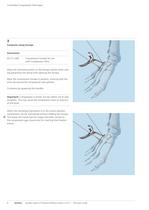
Controlled Compression Technique Compress using forceps with Compression Wire Move the ratcheting switch so the forceps ratchet when clos- ng preventing the spring from opening the forceps. Place the compression forceps in position, ensuring that the arms are around the compression wire spheres. Compress by squeezing the handles. Important: Compression is tactile, but be careful not to over compress. This may cause the compression wires to strip out When the ratcheting mechanism is in the correct position, compression can be maintained without holding the forceps. O This leaves the hands free...
Abrir la página 10 del catálogo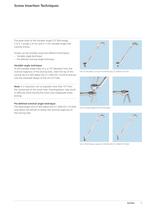
Screw Insertion Techniques The plate holes of the Variable Angle LCP Technology 2.4 / 2.7 accept 2.4 mm and 2.7 mm Variable Angle (VA) Locking Screws. Screws can be inserted using two different techniques: – Variable angle technique – Pre-defined nominal angle technique Variable angle technique To drill variable angle holes at a +/-15° deviation from the nominal trajectory of the locking hole, insert the tip of the conical VA-LCP drill sleeve (03.211.003 / 03.110.023) and key into the cloverleaf design of the VA-LCP hole. VA-LCP drill sleeve, conical, for Drill Bits (03.211.003/03.110.023) Note:...
Abrir la página 11 del catálogo
01.211 .X01 VA-/Cortex Screws 2.4, in Modular Tray, Vario Case System 01.211 .X02 VA-/Cortex Screws 2.7, in Modular Tray, Vario Case System 01.211 .X03 General Fusion Plates VA 2.4/2.7, in Modular Tray, Vario Case System 01.211.103 Instruments VA 2.4/2.7, in Modular Tray, Vario Case System Modular Tray, Vario Case System Select the plate according to the arthrodesis, osteotomy or fracture pattern and the anatomy of the patient. Note: This technique guide describes the application of VA locking plates for various indications in the forefoot and mid- foot of the "Variable Angle LCP Forefoot/Midfoot...
Abrir la página 12 del catálogo
Prepare joint surface Remove the cartilage and prepare the joint surface for an arthrodesis. The surface of the joint can be manipulated to achieve the desired correction. Open osteotomy Create an osteotomy starting from the medial side. Do not cut through the bone leaving the lateral cortex intact. Reduce fracture O Reduce the fracture under the image intensifier and if neces- sary, fix with Kirschner wires or reduction forceps. The reduc- tion method will be fracture-specific.
Abrir la página 13 del catálogoTodos los catálogos y folletos técnicos Depuy Synthes
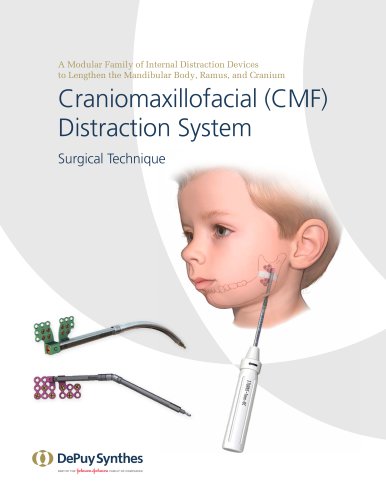 Craniomaxillofacial (CMF) Distraction System
100 Páginas
 Titanium Sternal Fixation System
34 Páginas
 Small Battery Drive II
4 Páginas
 Introducing The Variable Angle
12 Páginas

Catálogos archivados
 MatrixRIB®FixationSystem
86 Páginas
 HEALIX ADVANCE
4 Páginas
 HEALIX Anchor™ 3.4 mm
2 Páginas
 VA LCP ® Distal Radius System
8 Páginas
 External Midface Distractor System
43 Páginas
 3.5 mm LCP™ Medial
15 Páginas
 RADIUS OF CURVATURE
3 Páginas
 Building on Success
16 Páginas
 2.0 mm LCP® Distal Ulna Plate
20 Páginas
 2.4 mm VA LCP™
4 Páginas
 Mandible Trauma Solutions
2 Páginas
 Power line II
4 Páginas
 Concorde
28 Páginas
 LCP Intercarpal
31 Páginas
 LCS® COMPLETE™
2 Páginas
 Cementing Total Knee Replacements
12 Páginas
 CORAIL® Hip System Design Rationale
12 Páginas
 Synthes TPLO.
8 Páginas
 SynFix-LR System
56 Páginas
 ATB Anterior Tension Band Plate
32 Páginas
 CONDUIT™
15 Páginas
 Brochure_FINAL
2 Páginas
 DePuy Synthes
81 Páginas
 Anspach
3 Páginas
 Orthopedic Foot Instruments
32 Páginas
 PINNACLE® Hip Solutions
12 Páginas
 Corail
24 Páginas
 GLOBAL Advantage Surgical Technique
32 Páginas
 S-ROM® NOILES™
68 Páginas
 TRI-LOCK® Product Rationale
12 Páginas
 Reclaim Surgical Technique
44 Páginas
 DESIGN RATIONALE AND SURGICAL TECHNIQUE
28 Páginas
 PRODUCT RATIONALE AND SURGICAL TECHNIQUE
32 Páginas
 Speed
Speed2 Páginas
 attune
80 Páginas
 HAMMERLOCK® 2
2 Páginas
 DePuy Glenoid Solutions
2 Páginas
 Trauma Solutions. Elbow
4 Páginas
 Polar
Polar4 Páginas
 Alveolar Distractor.
4 Páginas
 Piezoelectric System
4 Páginas
 Air Power Line II
6 Páginas
 LCP Clavicle Hook Plate
4 Páginas
 TruMatch Pin Guides
16 Páginas
 P F N A
8 Páginas
 SKILL, DEDICATION,
16 Páginas
 Orthopaedics. Overview
20 Páginas
 DURALOC
16 Páginas
 Marathon Cemented Cup
20 Páginas
 REEF Surgical Technique
16 Páginas
 MatrixNEURO
8 Páginas
 Anspach XMax
4 Páginas
 Anspach eMax 2 Plus
4 Páginas
 Small Electric Drive
4 Páginas
 Air Pen Drive
4 Páginas
 Colibri II
4 Páginas
 Spine
Spine25 Páginas
 Epoca Shoulder Arthroplasty System
8 Páginas
 VA-LCP Elbow Plating System Promotional
12 Páginas
 MultiLoc Humeral Nailing System.
4 Páginas
 Headless Compression Screws 4.5 & 6.5
28 Páginas
 Expert Hindfoot Arthrodesis Nail
48 Páginas
 LCP Distal Fibula Plates
32 Páginas
 LCP Distal Tibia Plate - Low Bend
24 Páginas
 TomoFix
60 Páginas
 Expert Tibial Nail PROtect
16 Páginas
 Expert Tibia Nail
84 Páginas
 Sacral Bars
16 Páginas
 Pelvic C-Clamp
20 Páginas
 Low Profile Pelvic System
16 Páginas
 Proximal Femoral (Hook) Plate
24 Páginas
 LCP
LCP24 Páginas
 PFNA
PFNA112 Páginas
 HCS 1.5, 2.4, 3.0
36 Páginas
 LCP Wrist Fusion
32 Páginas
 LCP Compact Hand
28 Páginas
 VA-LCP Elbow
48 Páginas
 Distal Radius
44 Páginas
 Olecranon
30 Páginas
 LCP Hook Plate
28 Páginas
 DHP & Olecranon
4 Páginas
 LCP S-A
4 Páginas
 Epoca
Epoca4 Páginas
 Philos
32 Páginas
 MultiLoc
68 Páginas


- Placa ósea DePuy Synthes
- Placa de compresión
- Placa de compresión metálica
- Placa de compresión bloqueada
- Placa de compresión de titanio
- Placa de compresión porción distal
- Kit de instrumentos para cirugía ortopédica
- Caja intersomática
- Contenedor de esterilización
- Contenedor de esterilización para instrumental
- Sustituto óseo
- Clavo médica
- Clavo intramedular metálico
- Caja intersomática vía anterior
- Vástago femoral
- Placa de artrodesis
- Sustituto óseo para cirugía ortopédica
- Clavo intramedular para fémur
- Anclaje de sutura
- Placa de artrodesis metálica